
How is a saddle tree made ? Process, materials, and CNC manufacturing
Understanding the role of the saddle tree in a saddle
The saddle tree is the internal framework of the saddle. It determines the saddle’s shape, balance, and ability to distribute weight across the horse’s back.
Although it is invisible once the saddle is finished, it plays a crucial role in the horse’s comfort, the rider’s position, and the overall durability of the saddle.
The saddle tree is to a saddle what the chassis is to a vehicle : an invisible structure that is crucial to its performance.
Its design and manufacture require absolute precision, as it must conform to the horse’s anatomy while withstanding the mechanical stresses associated with its use.
Manufacturing designed for custom-made products
A saddle tree is not a completely standard product. It must be tailored to a specific combination : a horse, a rider, and a discipline.
At L’Arçonnerie Française, we offer a wide range of models, available in various sizes and options, allowing us to accommodate a wide variety of configurations and provide a product that comes as close as possible to a custom-made item.
For specific requirements, fully custom-made saddle trees can also be manufactured upon request, based on the measurements and specific constraints of each project.
This approach provides a reliable, consistent, and reproducible foundation for the work.
To ensure accurate fittings, we provide a guide for measuring a horse’s back. This document enables the saddler to record the essential measurements and ensure a perfect fit between the saddle tree and the horse’s body shape.
See the guide to measuring the horse's back
From design to technical specifications
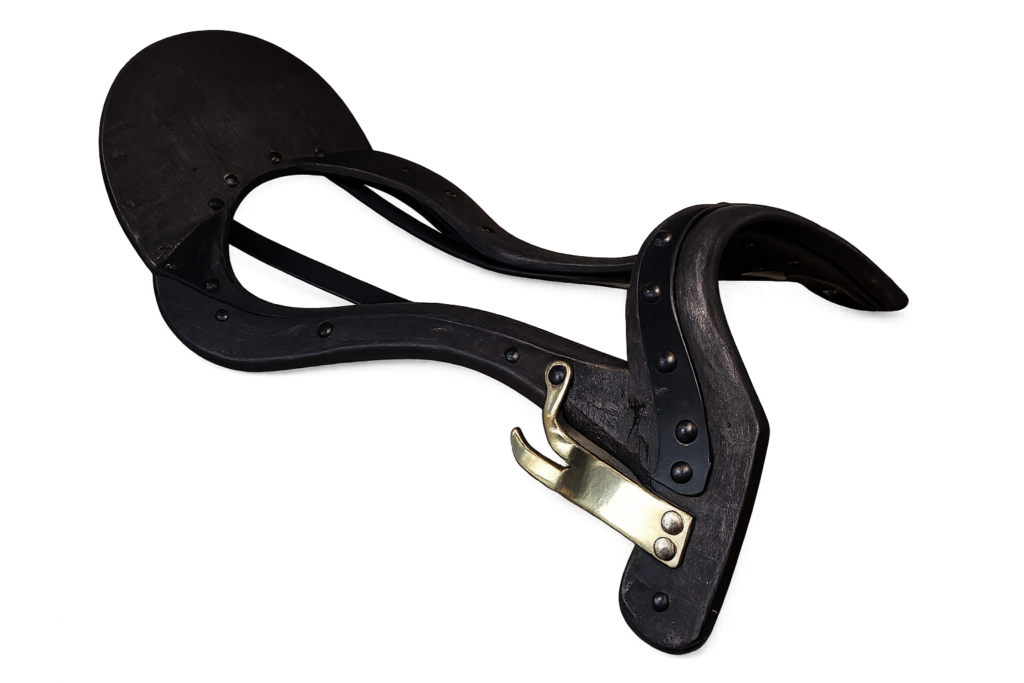
Manufacturing begins with a design phase, which defines the essential characteristics of the saddle tree :
- Opening and arch shape
- Longitudinal curvature
- Width of the bands
- Shape of the cantle
- Overall balance of the saddle
- Seat size
These settings determine how the saddle will sit on the horse and follow its movements.
The choice of materials : between tradition and innovation
Historically, the saddle trees have been made of wood, a material known for its mechanical properties and its ability to provide an excellent balance between rigidity and flexibility.
At L’Arçonnerie Française, we prefer beech wood, which is now the standard for the manufacture of high-end saddle trees. It produces reliable, durable structures that are perfectly suited to the needs of saddlers.
In addition, we also offer solutions made of Kevlar-reinforced polyurethane. These materials provide a more cost-effective alternative while maintaining high manufacturing precision and excellent mechanical properties.
Precision series production enabled by CNC technology
Depending on the requirements, the manufacture of a saddle tree can involve entirely custom work or be part of a controlled series production process.
The Centaurus range exemplifies this approach, combining traditional craftsmanship with advanced technology. Developed in collaboration with saddle makers, independent engineers, and the ICAM in Toulouse (France), these saddle trees meet the modern demands of equestrian sports in terms of lightness, durability, and consistency.
The manufacturing process involves several technical steps. Beech wood veneers are first assembled and then hot-pressed under a pressure of approximately 300 tons, ensuring a flawless bond.
The part is then machined using computer numerical control (CNC) machines, ensuring millimeter-level precision and perfect geometric reproducibility. This step is essential for ensuring the consistency of the shapes and the reliability of the mass-produced saddles.
Finally, the hardware installation and finishing touches are carried out with the same attention to detail as for custom-made pieces.
This expertise in series production provides saddle makers with a consistent and reliable foundation, which is essential for ensuring the reproducibility of saddles and the precision of their fittings.
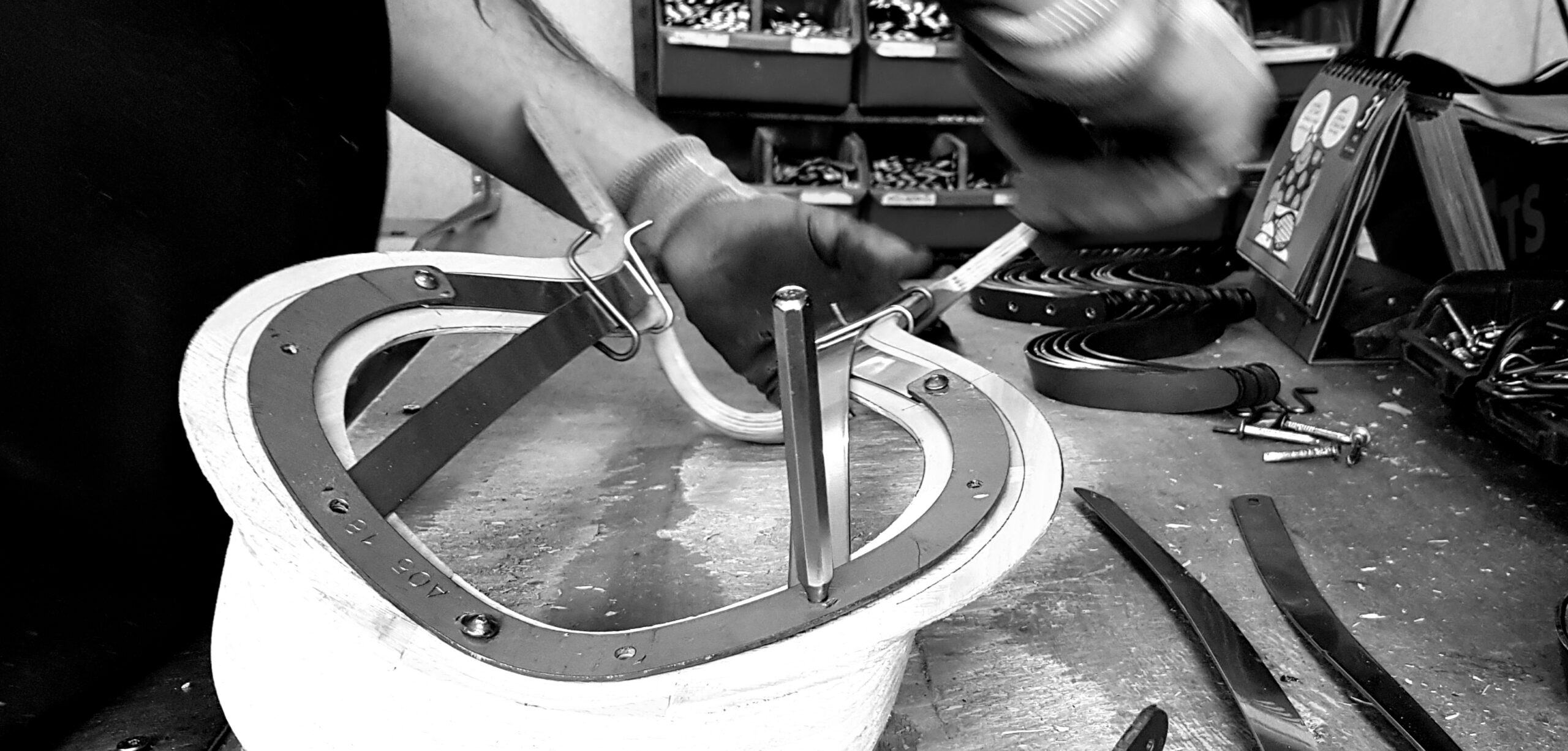
Series production process – CNC machining and manufacturing
A rigorous manufacturing process
The production of a saddle tree involves a series of carefully controlled steps :
- Wood cutting and sawing
- Shaping the structure and assembling the various parts (gullet , bands, cantle)
- Dimensional adjustment, rasping
- Dimensional inspection
- Fitting and Installation of Hardware
- Finishing touches (painting, stirrup bars assembly)
- Final inspection
Each step is designed to ensure the consistency of the geometry and the structural integrity of the assembly.
Assembling a saddle tree
Essential checks at every stage
A saddle tree must be perfectly symmetrical, stable, and conform to the specified dimensions.
Checks are conducted throughout the process to verify :
- Adherence to specifications
- The alignment of elements
- Structural consistency
This requirement is essential to ensure reliable results, particularly in the context of custom manufacturing.
Why is build quality so important ?
The quality of a saddle tree’s construction has a direct impact on how the saddle performs. Faulty geometry, a lack of symmetry, or structural irregularities can lead to imbalances, pressure points, or premature wear.
Conversely, a perfectly fitted saddle allows for better weight distribution, increased stability, and more precise work by the saddle maker.
It is this demand for precision that makes the saddle tree a key factor in the saddle’s overall performance.
Close collaboration with saddlers
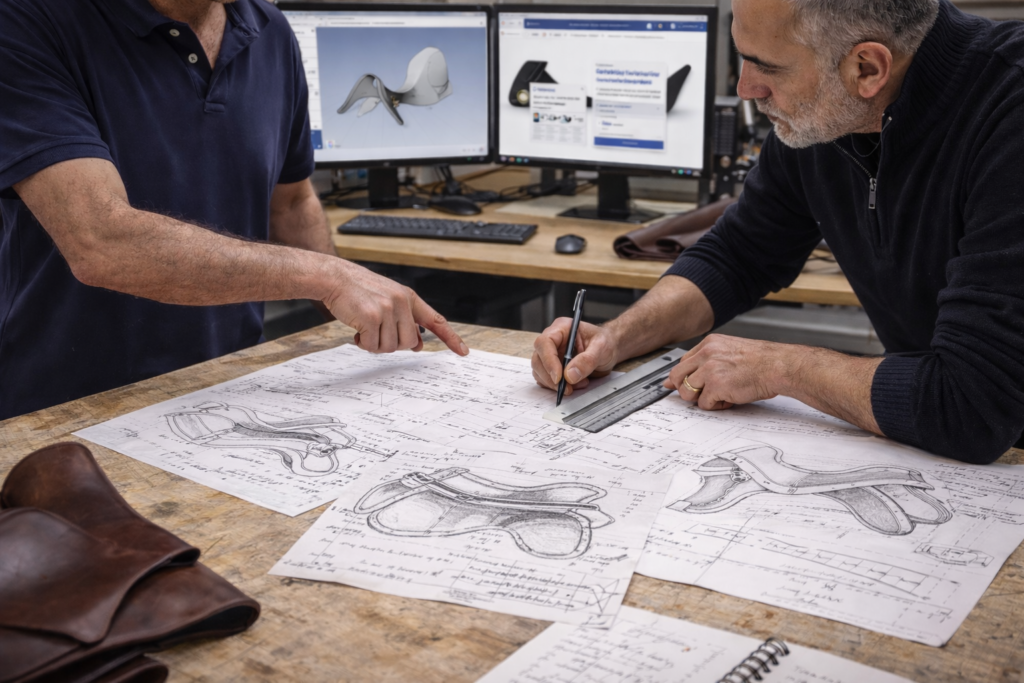
The crafting of a saddle tree is not merely a technical process. It involves close collaboration with saddlers.
Their feedback allows us to adapt the designs, improve certain aspects, and refine the shapes based on specific practices and disciplines.
This direct connection to the field is at the heart of L’Arçonnerie Française’s approach.
A key component for a high-performance, durable saddle
The saddle tree is the foundation of every saddle.
Its quality determines everything : stability, comfort, durability, and the precision of the saddler’s craftsmanship.
That is why its manufacture must combine technical expertise, mastery of materials, and a deep understanding of real-world needs.